
Product Design course is a 4-year full-time program offered by design colleges in India.
A product is something sold by an enterprise to its customers.
Product development activities begin with market identification and end with the production, sale, and delivery of a product.
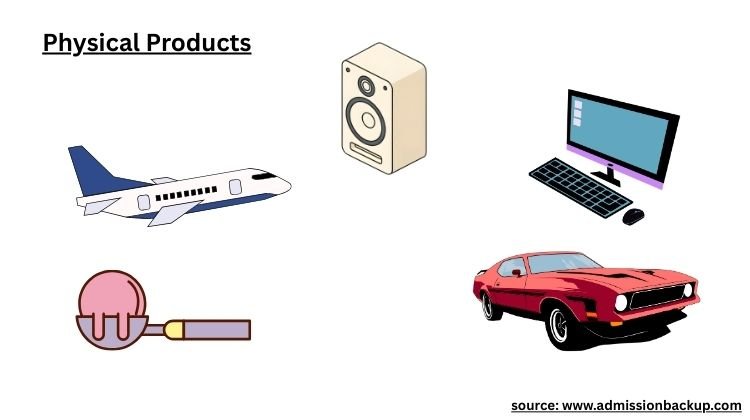
A product can be a physical product (books, toys, machines) or a virtual product (software, music, or video).
In this article, we will learn about the Product Design course.
This course covers various topics such as:
- Product Development Process
- Opportunity Identification
- Product Planning
- Identifying Customer Needs
- Product Specification
- Concept Generation
- Concept Selection
- Concept Testing
- Product Architecture
- Industrial Design
- Design for Envoirment
- Design for Manufacturing
- Prototyping
- Robust Design
- Intellectual Property
- Service Design
- Product Development Economics
- Project Management
Product Development Process
Product Design course is an interdisciplinary activity that includes:
- Marketing: Identification of product opportunities
- Manufacturing: Production systems (Engineering and Industrial Design)
- Design: Physical form of the product
Some of the common factors that affect the product design process are:
- Structured Methods: A timeline to build the product and deliver it to customers
- Industrial Examples: Electronic devices, automobiles
- Organizational Realities: Cost, team, experience, and innovation
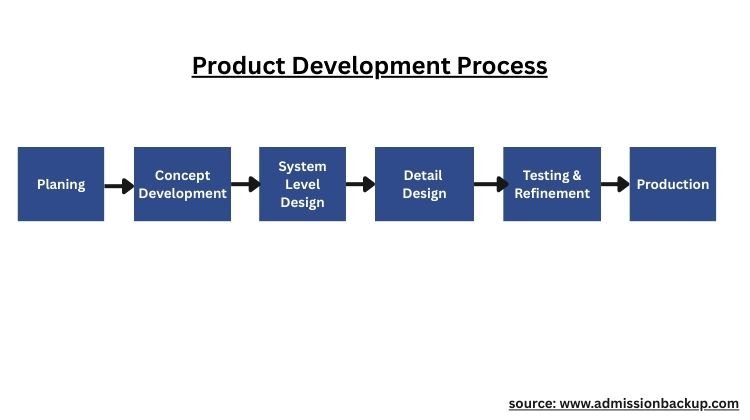
The Product Development Process is a sequence of steps that converts inputs into outputs.
It is a set of activities carried out by an enterprise to conceive an idea and build a commercial product, such as:
- Planning
- Concept Development
- Product Design
- Detailed Design
- Testing and Refinement
- Production
Opportunity Identification
An opportunity is an idea for a new product.
It can be a variant of an existing product or a next-generation product idea.
Opportunity identification is a process that depends on various factors such as:
- Product need
- Cost
- Competitive strategies
- Experience and capability
- Possibility of imitation
Opportunities must be properly evaluated before proceeding with product design.
All profitable products undergo rigorous opportunity identification techniques such as screening, customer feedback, surveys, etc.
Product Planning
Product planning identifies the portfolio of products to be developed by an organization.
Fundamentally, it can involve a new product, platform projects (such as wireless technology, Android, etc.), or improvements to existing products.
Technology implementation, cost, and time analysis are major considerations in product planning.
- Technology: Should be easy to use
- Cost: Must be affordable or positioned as a high-end product
- Time: Timeline to introduce the product to the market
- Competition: Effective use of resources to launch a product in competitive markets
Identifying Customer Needs
Identifying the target market for selling a product is the primary goal of a product designer.
Surveying customers through interviews and collecting raw data helps in identifying customer needs and requirements for a product.
An interviewer can ask questions to identify all the needs of a customer.
Some needs may not be technically feasible.
Needs are useful for analyzing the attributes of a product and defining its specifications.
Customer needs can be classified as primary, secondary, and tertiary to establish a hierarchical list of needs.
A great product addresses most of the critical needs of a customer.
Identifying customer needs is a crucial step in the concept development phase of the product development process.
Customer needs are helpful in generating product concepts and defining product specifications.
Product Specification
Product specification is a measurable term or metric that defines customer needs, such as:
| Need | Specification |
|---|---|
| Must be lightweight | Weight in kilograms (kg) |
| Must be portable | Dimensions |
| Must be affordable | Cost |
| Must pass safety tests | Product Ratings |
Concept Generation
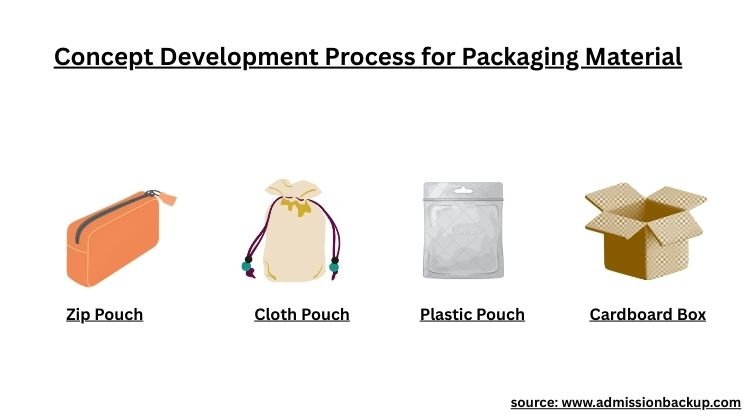
A product concept is an approximate description of the technology, working principle, and form of the product.
A concept is usually a sketch or a three-dimensional model accompanied by a textual description.
The mission statement, customer needs list, and product specifications are inputs to the concept generation process.
Benchmarking is the study of existing products with functionality similar to the product under development.
It reveals the existing technology in use, as well as the strengths and weaknesses of the competition.
Concept Selection
The concept selection process is a crucial part of the product development process.
It ensures that the selected concepts have the potential to satisfy customer needs and achieve economic success.
Some of the parameters used for concept selection are:
- Ease of use
- Ease of manufacturing
- Manufacturing cost
- Choice of materials or colors
- Product safety
Concept selection is carried out in two phases: concept screening and concept scoring.
Concept screening is the process of evaluating concepts against various criteria.
Concept scoring is performed to select the winning concept and finalize the best product specifications.
Concept Testing
Concept testing is the phase that tests the demand for a concept after gathering consumer needs and defining the product description and specifications.
Product developers communicate the product concept to ideal buyers through surveys, verbal descriptions, photos, sketches, storyboards, videos, computer simulations, physical appearance models, or working prototypes.
Based on consumer feedback, the ideal market for the product is defined, and forecasts and predictions are made regarding the number of units that can be sold.
Product Architecture
The interaction of several subsystems and components is called product architecture.
Product architecture is the phase in which different functional elements of a product are arranged into physical chunks.
All functional elements of a product work together to form the physical product.
For example, a printer has various subsystems such as cartridge, power supply, paper holder, scanner, etc.
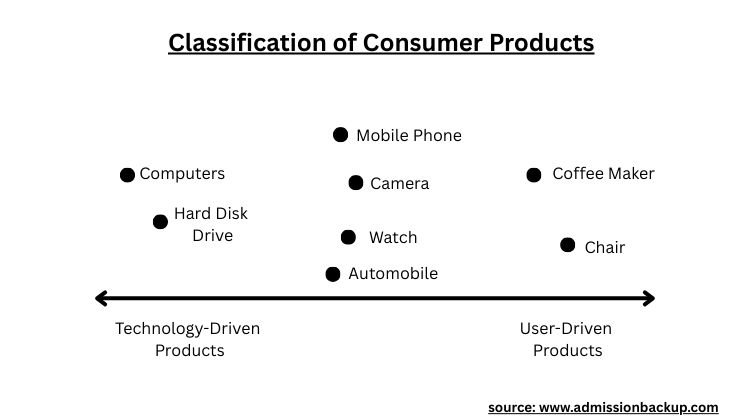
Industrial Design
Industrial Design is an area of study that deals with the mass production of goods.
It increases product appeal and customer satisfaction through better features, strong brand identity, usability, and an affordable price.
Industrial Design deals with user experience design and aesthetics such as:
- Ease of maintenance
- Product features
- User interaction
- Safety
- Environmentally friendly design
- Branding
- Motivation
- Product differentiation
Industrial Design contributes to product success by increasing the market share of a product, enabling premium pricing, etc.
Design for Envoirment
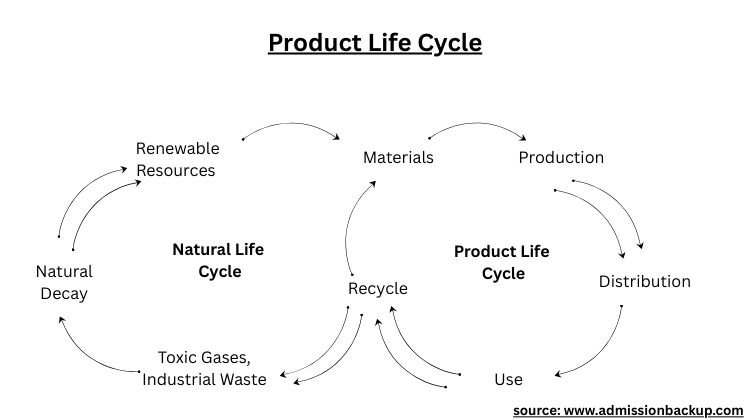
Environmental factors must be taken into consideration during the product development process.
Design for the environment expands the manufacturer’s focus to consider the full product life cycle and its relationship to the environment.
Products must be recyclable to reduce harmful effects on the environment.
Industrial waste and pollutants are harmful to the environment.
Design for Manufacturing
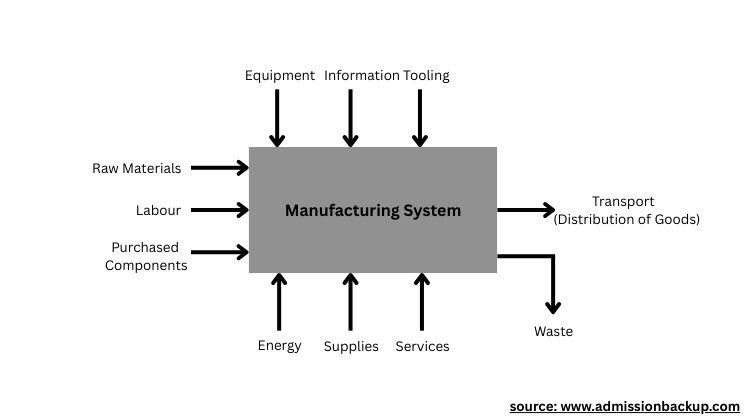
Cost is a major factor associated with manufacturing.
It involves the procurement of raw materials, labor, equipment, the assembly line, and the supply chain to mass-produce goods and distribute them among consumers.
A product design course helps you understand the production process and apply the best strategy to reduce production costs.
The cost of product development and product quality are important factors for its success in the target market.
Prototyping
Prototyping is the process of building a physical or virtual model of a product.
Prototypes are used as physical models to showcase a product to customers and for major testing purposes before final production.
It helps in communicating the vision of the organization among its stakeholders and customers.
Virtual prototypes such as images, sketches, computer-aided design (CAD), and 3D printing are helpful in exploring various design patterns.
Robust Design
The robust design process checks the performance of products under non-ideal conditions, such as physical crash testing.
It is an activity in the product development process that helps in improving the desired performance of products.
A product must undergo various safety tests and experiments to check for robustness and durability before it is sold to customers.
Intellectual Property
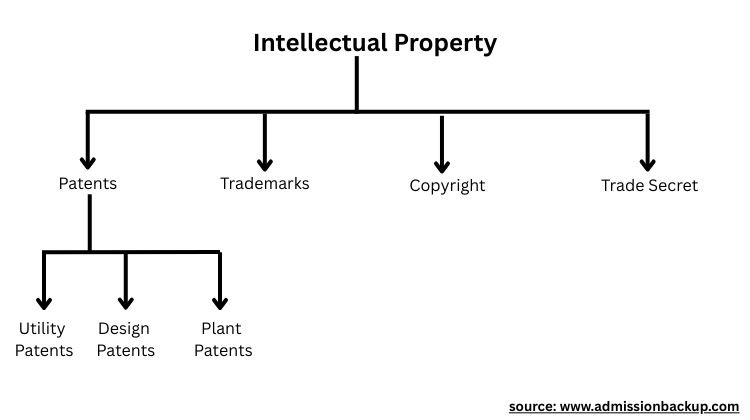
Intellectual property rights are granted by the government.
They grant a temporary monopoly to exclude others from using, making, and selling an invention.
Patents are usually filed for most technology-based product development efforts.
They safeguard the interests of the inventor and allow further development and commercialization of the product.
Service Design
Services and products form an overall portfolio of an organization’s offerings to its customers.
Service-based businesses include banking, insurance, stock market investment, consulting, internet services, healthcare, etc.
Similar to product design, the identification of customer needs is essential for any service design.
Products and services are sold together and form an ecosystem in the product-service market.
Product Development Economics
The product development team requires time, resources, and cost.
The sale of the product is essential to fund the product development process.
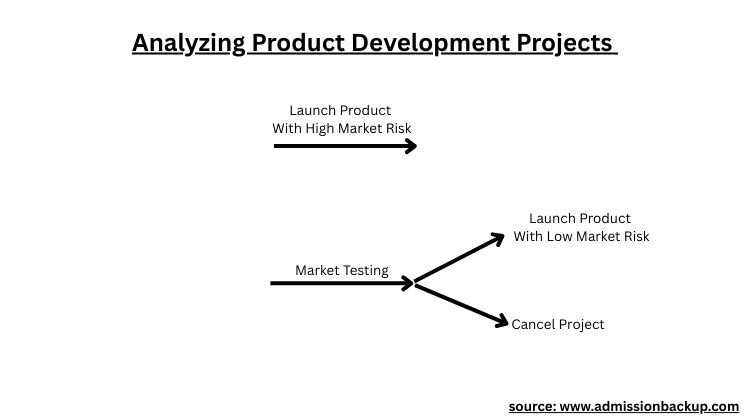
Trade-offs such as return on investment (ROI) and affordability help inform decision-making.
Some of the factors that affect product development economics are:
- Cost
- Time
- Tooling and equipment cost
- Retail price
- Sales volume
- Product usability
Project Management
Project management involves various tasks such as planning, coordination, assessment, execution, budgeting, and staffing.
Project manager is in charge of the project and coordinates with employees to execute tasks.
A project consists of several tasks linked to each other.
Project planning is a crucial step in the product development process.
Product Design Course Admission Process
Students who wish to pursue a B.Des/M.Des in Product Design must fulfill the eligibility criteria, such as:
- Must have completed 10+2 from a recognized board (CBSE, ICSE, or State Board).
- Must have studied in classroom-based regular mode only.
- Must have secured a minimum of 50% marks in Class 12.
- Must have valid documents such as identity proof.
The Bachelor of Design is a 4-year (8-semester) full-time course offered in various specializations such as Product Design, Industrial Design, etc.
The Master of Design is a 2-year (4-semester) full-time course.
Students can apply online for B.Design admission or consult education consultancies for direct admission.
The annual tuition fee varies from 2 lakh to 3 lakh INR per annum for the B.Design course.
Top Colleges Offering B.Des Product Design Courses
Some of the top colleges that offer product design courses are located in Bangalore, Karnataka.
- Indian Institute of Science
- PES University
- Alliance University
- Presidency University
- Pearl Academy
- Dayananda Sagar University
- JAIN University
- CMR University
- Ramaiah University of Applied Sciences
- Manipal Academy of Higher Education
Job Opportunities after B.Des in Product Design
A B.Des in Product Design offers a diverse range of career opportunities for graduates as product designers, industrial designers, UI/UX designers, interior designers, jewellery designers, textile designers, game & VFX design.
Product designers can be employed in a wide range of sectors, including:
- Consumer electronics
- Automobile industry
- Service sector
- Lifestyle and furniture
Expected Salary Level for Product Designers:
Entry level: 3 lakh to 6 lakh INR CTC
Mid level: 6 lakh to 12 lakh INR CTC
Senior level: 12 lakh to 20+ lakh INR CTC
FAQ’s about Product Design Course
The product design course covers various topics, including product planning, customer needs identification, concept generation, concept selection, product specification, system-level design, industrial design, product development economics, and project management.
PES University, JAIN University, Alliance University, and Presidency University are top universities that offer a 4-year full-time Bachelor of Design (B.Des) course.
Product designers earn a handsome salary. Entry-level roles offer 3 lakh to 5 lakh INR CTC, while mid-level roles offer 5 lakh to 8 lakh INR CTC.
Students can pursue a wide range of courses such as industrial design, textile design, interior design, user interface and user experience design, game & VFX design, jewellery design.
Conclusion:
Industrial Design, Engineering, and Marketing are three major areas that lead to the success of any product in the marketplace.
Industrial designers gather customer needs, design sketches, build prototypes, and draw models of product concepts and features.
They work closely with engineering and manufacturing teams throughout the product development process.
A good product exhibits the following properties:
- Usability
- Emotional appeal
- Ability to repair
- Appropriate use of resources
- Product differentiation
Industrial design graduates help build corporate identity, enhance customer satisfaction, and increase market size.
For career consultation, please contact our helpline at +91 8546881677.


A Kids’ Dictionary