Database management system course spans across using computer systems to store records and manipulate object records.
Object records can be stored in a database system rather than a conventional file processing system.
An object is a file which has various attributes and identity such as age, gender, address, phone number, salary, etc.
Processing of object records helps build a wide range of internet applications for business organizations, government & individuals.
Banking, e-commerce, and social media applications are built on database management systems.
Here in this article, we will learn about the Database Management Course (DBMS).
We will cover various topics including:
- Introduction to the DBMS Course
- Relational Languages
- Database Design
- Application Design & Development
- Big Data Analytics
- Storage Management & Indexing
Introduction to DBMS Course
DBMS Course is a part of the computer science engineering syllabus and can be pursued separately through various online learning platforms.
Data manipulation language such as SQL enables users to access or manipulate data such as:
- Retrieval of information
- Insertion of new information
- Deletion of information
- Modification of information stored in the database
People who work with a database are categorized as database administrators.
Users interact with the database system by using user interfaces such as mobile or web applications.
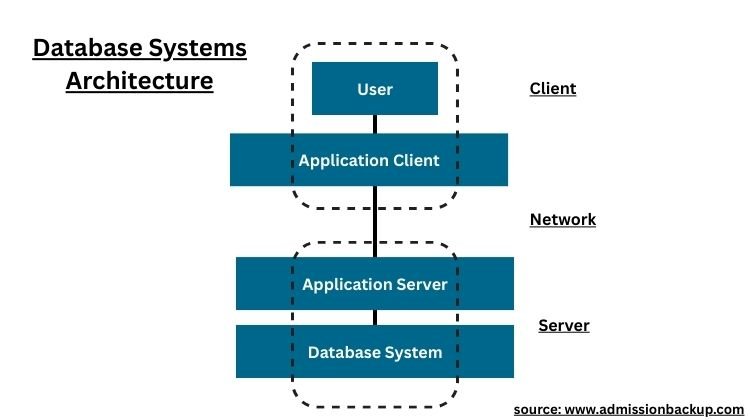
Also, the database system must protect the data from attempts of unauthorized access.
Students must learn Structured Query Language (SQL) to access and manipulate data.
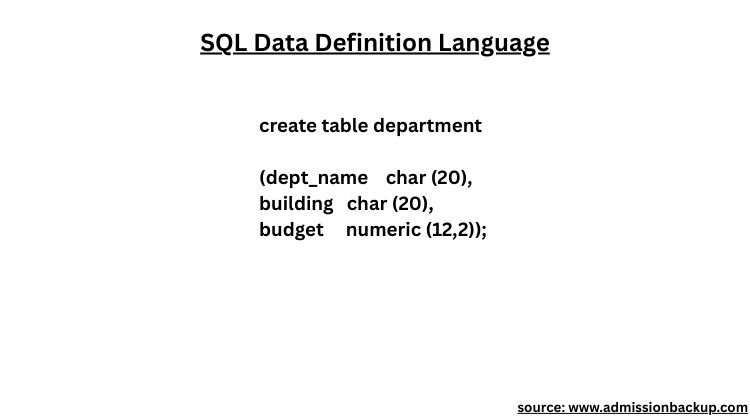
Database design involves the design of a database schema using a data definition language.
Data definition language is a language for specifying a database schema and other properties of the data.
Relational Languages
Structured Query Language (SQL) is widely used for database system design, such as describing data, data relationships, and performing various relational operations.
Relational operations include arithmetic (+, -, ×, ÷, count), comparison (<, >, =, true, false), and set operations (union, intersect, nested looping).
The relational data model is based on a collection of tables.
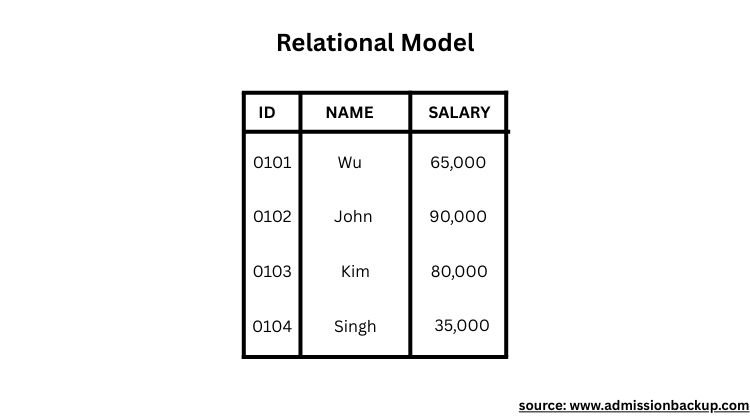
The relational algebra defines a set of algebraic operations that operate on tables and output tables as their result.
Many relational database products are now commercially available and are offered by companies including IBM, Oracle, Microsoft, SAP, etc.
Popular open source relational database systems include MySQL and PostgreSQL.
SQL is the most important relational query language.
It includes a variety of constructs for queries on the database (SELECT, FROM, WHERE clauses).
SQL is compatible with a wide range of general purpose programming languages such as C++, Java, PHP, and Python to perform database queries.
Database Design
Database systems are designed on the entity relationship (E-R) model.
Entity is an object such as a college student or a bank employee.
Entity has various attributes such as name, sex, phone number, address, salary, etc.
Attributes have values such as name: xyz, sex: male, phone number: +91 124…, etc.
A relational database follows the E-R model as it can efficiently edit, delete, update, and sort attribute values of multiple entities stored in a database.
Database design provides convenient graphical representations of data and its relationship with object attributes and other entities through mobile and web applications.
A relationship is an association among several entities.
Application Design & Development
Building applications focusing on the interactive use of databases to store and retrieve data requires the study of tools and technology.
Relational database design has tables with a fixed number of attributes; each attribute contains an atomic value.
JavaScript Object Notation (JSON) and Extensible Markup Language (XML) are preferred formats for data exchange in relational database systems.
JSON is an object file that contains a textual representation of complex data.
XML files add tags enclosed in angle brackets, <>, to represent data.
A query language allows object-relational mapping with its attributes.
It enables the creation, modification, and deletion of object attributes through the application interface.
The two most widely used classes of user interfaces include web and mobile applications.
Early generation web browsers only displayed HTML code.
Client-side scripting languages are designed to execute in the client browser, providing interactive features beyond the limits of HTML.
JavaScript is the most widely used client-side scripting language.
The client-side interface stores and retrieves data from backend servers.
Big Data Analytics
User-generated data is far exceeding enterprise data.
Such data is called Big Data.
Modern database management systems analyze Big Data to understand information about their users and to target advertisements and marketing campaigns.
Big Data requires the processing of very large volumes of text, images, speech, and video.
Data analytics systems analyze online data collected by transaction processing systems along with data from other sources.
Data warehousing helps archive and gather important operational data.
Extract, Transform, and Load (ETL) tasks are important steps in building and maintaining a data warehouse.
Storage Managememt & Indexing
Although database systems provide a high-level view of data, ultimately the data has to be stored as bits in physical storage devices.
Data is stored as files on magnetic disks and flash-based solid-state drives (SSDs).